Get Confused between the two major types of cooling systems? This AC Buying Guide 2026 is for you. We will break down the main differences between Split and Window ACs, delve into the long-term costs and help you determine which unit fits your particular living space and budget.
Get Confused between the two major types of cooling systems? This AC Buying Guide 2026 is for you. We will break down the main differences between Split and Window ACs, delve into the long-term costs and help you determine which unit fits your particular living space and budget.
1. Understanding the Basics: Split vs. Window AC
Before getting into the technical details, it is important to understand the structural differences between these two cooling giants.
Window Air Conditioners
The Window AC is a single-unit system where all components—the compressor, condenser, expansion valve, and evaporator—are housed in one box. It is designed to be installed in a window sill or a dedicated wall opening.

- The Advantage: It is generally more affordable and easier to install. Because it is a single unit, it requires no complex piping between indoor and outdoor sections.
- The Drawback: It can be quite noisy since the compressor is located right inside the room. It also requires a specific window or wall structure that can support its weight.
Split Air Conditioners
A Split AC consists of two separate units: the indoor unit (which houses the cooling coil and blower) and the outdoor unit (which houses the compressor and condenser). These are connected by copper piping and electrical cables.
- The Advantage: They are significantly quieter because the noisy compressor is kept outside. They also offer a more modern aesthetic and can be installed on almost any wall without needing a window.
- The Drawback: They are more expensive upfront and require professional installation that involves drilling and securing an external bracket.
2. Key Factors to Consider (Comparison Table)
To make an informed decision, you must compare how these units perform across several critical categories.
+------------------------+---------------------------------------+----------------------------------------+
| Feature                | Window AC                             | Split AC                               |
+------------------------+---------------------------------------+----------------------------------------+
| Initial Price          | Lower (Budget-friendly)               | Higher (Premium)                       |
| Noise Level            | High (Compressor is inside)           | Very Low (Compressor is outside)       |
| Installation           | Simple & Portable                     | Complex & Permanent                    |
| Energy Efficiency      | Generally 3-star max                  | Available in high 5-star ratings       |
| Aesthetics             | Bulky; blocks a window                | Sleek; blends with wall decor          |
| Maintenance            | Easier and cheaper to service         | Requires professional cleaning         |
+------------------------+---------------------------------------+----------------------------------------
3. Tonnage and Room Size: Getting the Math Right
No matter which type you choose, buying the wrong capacity (tonnage) will lead to higher electricity bills and poor cooling. Use this general rule of thumb for 2026 standard room sizes:
- Up to 100 sq. ft.: 0.8 to 1.0 Ton
- 100 to 150 sq. ft.: 1.5 Ton
- 150 to 250 sq. ft.: 2.0 Ton
Pro Tip: If you live on the top floor of a building or have a room that faces the afternoon sun directly, always go for a slightly higher tonnage (e.g., choose a 1.5 Ton unit for a 120 sq. ft. room) to compensate for the heat gain.
4. Why Inverter Technology is the “Gold Standard” in 2026
In this AC Buying Guide 2026, we strongly recommend opting for Inverter ACs regardless of the type.
- Standard AC: The compressor is either “On” (running at full speed) or “Off.” This creates temperature fluctuations and consumes more power during the startup phase.
- Inverter AC: The compressor runs at variable speeds. It slows down once the desired temperature is reached, maintaining a consistent environment while consuming up to 30-40% less electricity.
In the long run, the electricity savings from an Inverter AC will easily pay back the higher initial purchase price within two to three years.
5. Modern Features to Look For
To ensure your AC remains relevant and efficient throughout the decade, look for these advanced features:
- Copper Condenser Coils: Copper is more durable, easier to repair, and offers better heat exchange compared to aluminum coils.
- Anti-Corrosive Coatings: Features like “Blue Fin” or “Gold Fin” protect the external unit from rust, especially if you live in coastal or high-humidity areas.
- Smart Connectivity: In 2026, most mid-to-high range ACs come with Wi-Fi support, allowing you to control the temperature via a smartphone app or voice assistants like Alexa and Google Assistant.
- PM 2.5 Filters: With rising pollution levels, many ACs now double as air purifiers, filtering out fine dust particles to ensure the air you breathe is clean.
FAQs: AC Buying Guide 2026
Which AC consumes less electricity, Split or Window?
Generally, Split ACs are more energy-efficient. Because they have more space for larger condenser coils and are more likely to feature advanced 5-star inverter technology, they typically offer better ISEER (Indian Seasonal Energy Efficiency Ratio) ratings than Window units.
Can I install a Split AC in a rented apartment?
Yes, but remember that Split AC installation involves drilling holes for the pipes and installing a heavy outdoor unit on the facade. Always get permission from your landlord. If you move frequently, a Window AC is much easier to unmount and transport.
How often should I service my AC?
For optimal performance, you should clean the dust filters yourself every two weeks. A professional service, including a “wet wash” for the coils, should be done at least twice a year—once before the summer begins and once after the monsoon ends.
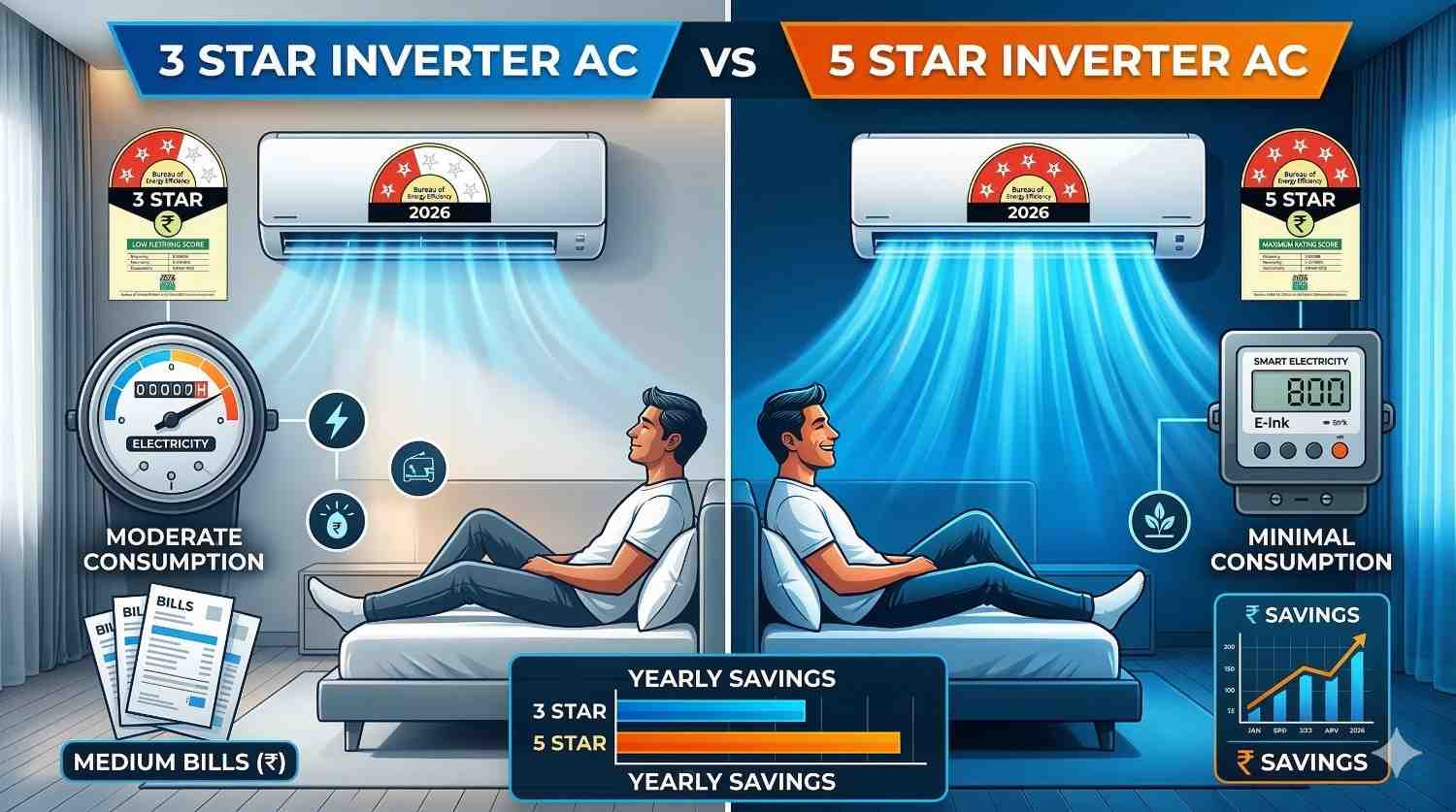
Are 5-star ACs worth the extra money?
If you plan to run your AC for more than 4–6 hours a day, a 5-star rating is definitely worth it. If the AC is for a guest room that is rarely used, a 3-star unit might be more cost-effective.
The Verdict: Split or Window?
- Buy a Window AC if: You are on a tight budget, have a pre-existing window slot, or live in a rented space where you move every year. It is a rugged, “no-frills” cooling solution.
- Buy a Split AC if: You want a silent room, have no window in the room, or want the highest possible energy savings. It is a long-term investment in comfort and aesthetics.
By following this AC Buying Guide 2026, you can confidently choose a cooling system that keeps you comfortable while keeping your energy bills under control.