The year 2026 marks a “Software-Defined” overhaul of the Indian regulatory landscape. As we cross the threshold of April 2026, the decades-old frameworks governing our taxes, travel, and digital identities have been replaced. If you are asking about new government rules in 2026, you are looking at a shift toward “Viksit Bharat”—where transparency is the new “vibe” and digital verification is mandatory.
From the implementation of the Income Tax Act 2025 to stricter “software-defined” safety rules for social media, these changes aren’t just incremental; they are structural. Whether you are a salaried employee, a car owner, or a casual Instagram user, here is how the new rules will impact your daily life.
1. Taxation: The Entry of the Income Tax Act 2025
The biggest “vibe” shift of the decade is the official replacement of the 1961 Act with the Income Tax Act 2025. Effective April 1, 2026, this new law simplifies the “software-defined” language of taxation.

- Tax Year Concept: The terms “Assessment Year” and “Financial Year” have been merged into a single “Tax Year.” * ITR Deadline Extension: For non-audit taxpayers (ITR-3 and ITR-4), the filing deadline has been pushed to August 31, giving you an extra month to manage your “software-defined” filings.
- New Forms: Say goodbye to Form 16 and 26 AS. Under the 2026 rules, Form 130 (salary certificate) and Form 168 (tax credit statement) are the new standards.
2. Digital Identity: Mandatory Social Media KYC
In a move to curb cybercrime and fake “vibes,” the government has proposed a “software-defined” identity check for social media.
- KYC for X, Meta, and YouTube: Users may soon be required to verify their accounts using Aadhaar or PAN.
- Anonymous Accounts: The era of anonymous trolling is ending. Platforms are being pushed to verify “Software-Defined” identities to ensure accountability.
- Children’s Safety: Stricter age verification and parental consent rules are now part of the “software-defined” framework for users under 18.
3. Banking & PAN: New Cash Deposit Limits
The new government rules in 2026 have significantly widened the net for PAN card reporting.

- ₹10 Lakh Threshold: Quoting your PAN is now mandatory for total cash deposits or withdrawals exceeding ₹10 Lakh in a year (up from the daily ₹50,000 limit).
- Insurance & Investments: You now need a PAN for any “Software-Defined” account-based relationship with an insurer or for investing more than ₹50,000 in mutual funds or RBI bonds.
- Property Transactions: For any “software-defined” property deal above ₹20 lakh, PAN disclosure is a non-negotiable “vibe.”
4. On the Road: The 20-Year Scrappage Rule
If you own an old vehicle, the “software-defined” clock is ticking. The National Vehicle Scrappage Policy is now in full force across India.

- Private Vehicles: Once your car hits the 20-year mark, it must undergo a mandatory fitness test at an Automated Testing Station (ATS).
- Commercial Vehicles: The limit is 15 years.
- Pass or Scrap: If your vehicle fails the “Software-Defined” emissions or safety test, it is marked as an “End-of-Life Vehicle” (ELV) and must be scrapped.
- Incentives: Scrapping your old “vibe” can get you a 25% road tax rebate on a new vehicle and a registration fee waiver.
5. Digital Payments: Mandatory 2-Factor Authentication
The RBI has tightened the “software-defined” security for every digital transaction you make.

- Universal 2FA: Whether it’s UPI, credit cards, or net banking, two-factor authentication (OTP + PIN or biometrics) is now mandatory for all transactions.
- FASTag Revision: The “software-defined” annual pass fee for private vehicles has been revised to ₹3,075 for FY 2026-27.
6. Real Estate: 50% HRA Exemption in 8 Cities
The “Software-Defined” definition of “Metro Cities” for tax purposes has finally expanded.
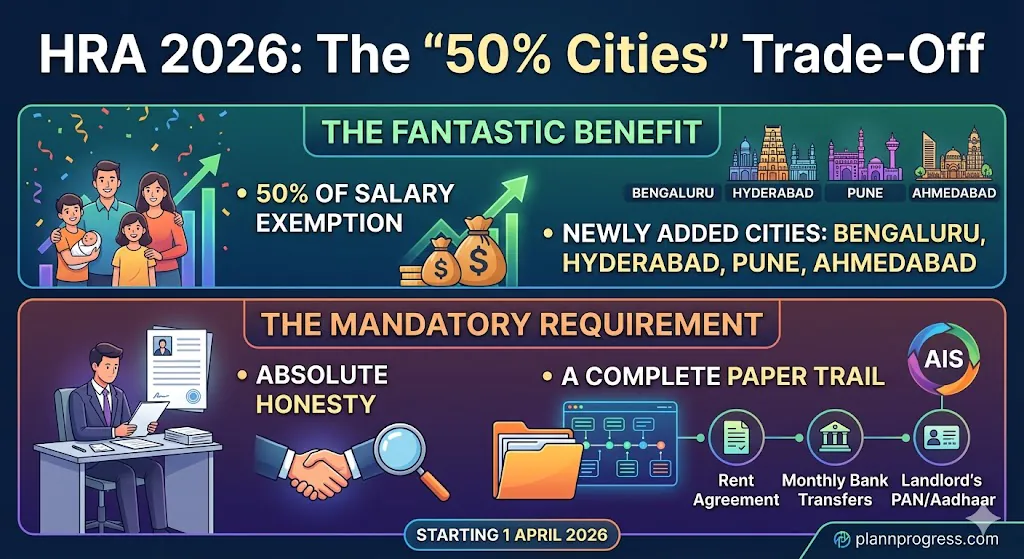
- The New List: Residents of Bengaluru, Pune, Hyderabad, and Ahmedabad can now claim a 50% HRA exemption, matching the “vibe” of Delhi, Mumbai, Kolkata, and Chennai.
- Impact: This is a massive “Software-Defined” win for salaried employees in these tech hubs, leading to significant tax savings.
7. Investing: The End of Secondary SGB Tax Breaks
If you enjoy the “vibe” of Sovereign Gold Bonds (SGBs), take note of the “software-defined” tax shift.

- Primary vs. Secondary: Capital gains tax exemption on maturity now applies only to original subscribers.
- Secondary Market: If you buy SGBs from the secondary market (stock exchange) in 2026, you will have to pay capital gains tax even if you hold them until maturity.
Adapting to the 2026 “Vibe”
The new government rules in 2026 are designed to make India a more “software-defined” and transparent economy. While the transition—from new ITR forms to mandatory vehicle fitness tests—might feel overwhelming, these rules aim to reduce long-term “friction” and protect your digital and financial security.
Don’t wait for a “software-defined” penalty to strike. Update your PAN, check your vehicle’s registration date, and embrace the new tax year with confidence.
Frequently Asked Questions (FAQs):
• Is the old tax regime still available under the Income Tax Act 2025?
Yes. Even under the new government rules in 2026, the dual-regime system continues. However, the “software-defined” language of the new act makes the new tax regime the default choice for all taxpayers unless they manually opt-out.
Can I still use my old car after 20 years in 2026?
Yes, but only if it passes the “software-defined” fitness test at an automated testing station (ATS). If it passes, you get a one-year fitness certificate. If it fails, the “vibe” of that car ends, and it must be scrapped.
What is the new name for Form 16 in 2026?
Under the Income Tax Rules 2026, the traditional Form 16 has been revamped and is now known as Form 130. Similarly, your tax credit statement (26AS) is now Form 168.