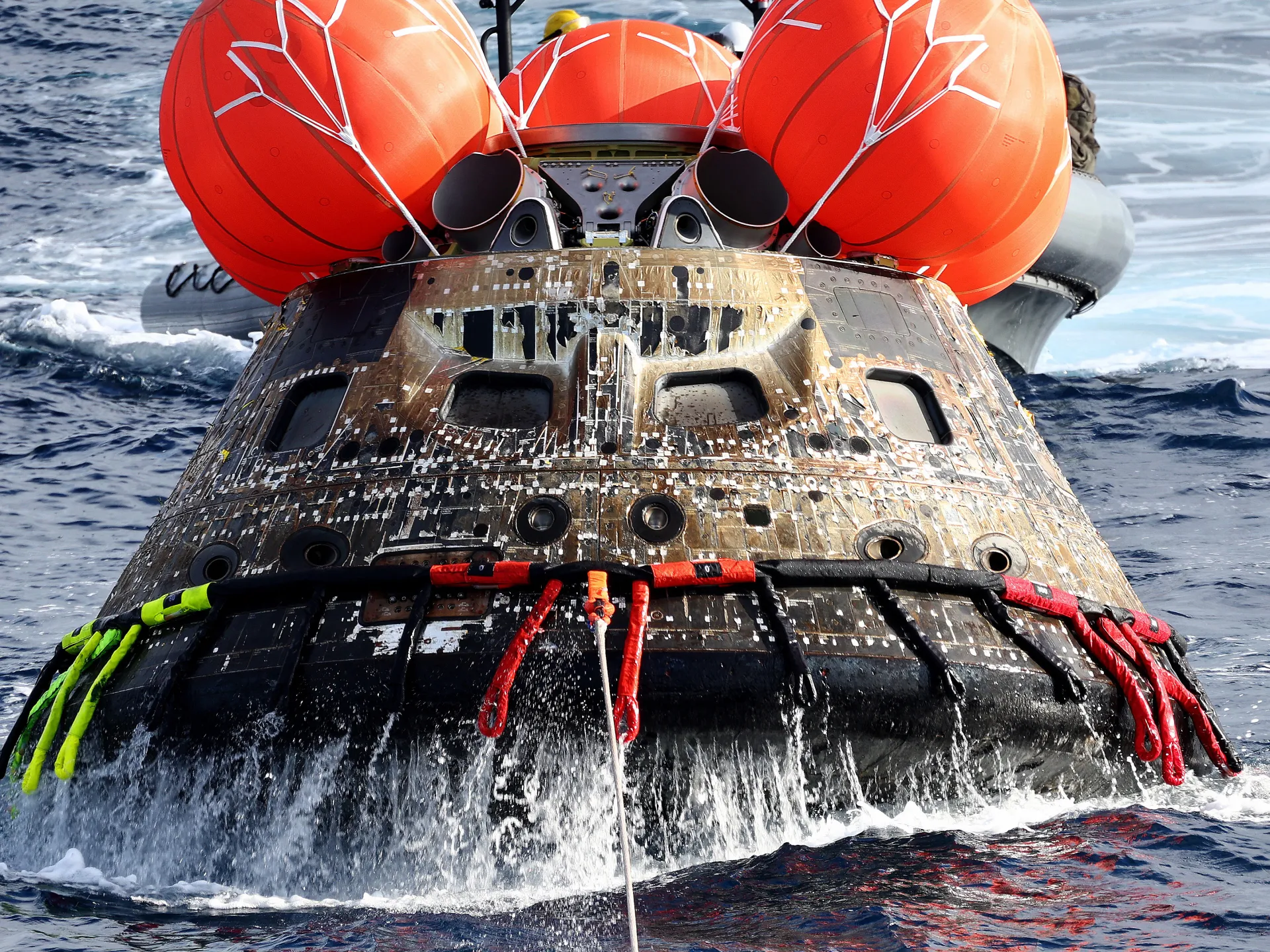
As a streak of fire tore through the sky, the world’s eyes were on the Pacific Ocean. It was a sign that the newest pioneers of humanity were back. NASA officially welcomed the Artemis II Moon mission crew back home on April 10, 2026. This marked the end of the first crewed trip to the Moon’s vicinity in more than 50 years.
This wasn’t just a flight; it was proof of how smart people are and the first step toward our permanent return to the moon. The Orion spacecraft, which had four brave astronauts on board, safely landed off the coast of San Diego after a 10-day mission that pushed the limits of deep-space exploration.
The Historic Return of the Artemis II Moon Mission Crew
The return home of NASA astronauts Reid Wiseman, Victor Glover, and Christina Koch, along with Canadian Space Agency astronaut Jeremy Hansen, was like something out of a movie. The crew flew almost 700,000 miles after launching on April 1st from the powerful SLS rocket.
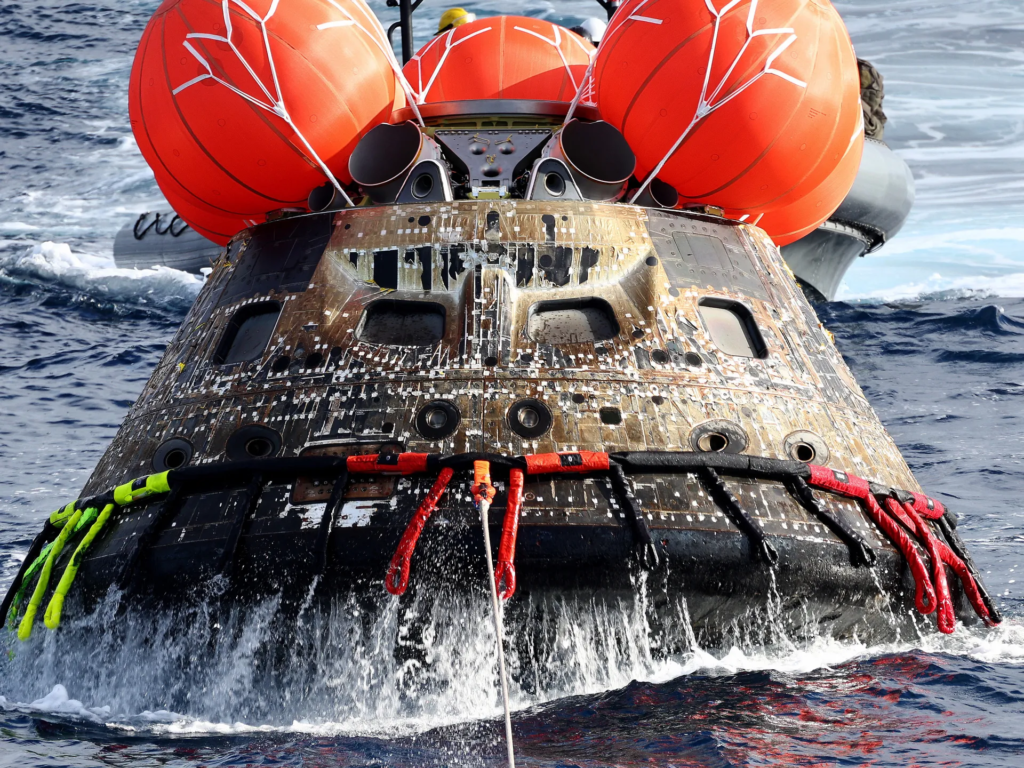
Their return was a risky physics lesson. The Orion capsule, called Integrity, entered the Earth’s atmosphere at Mach 33, which is about 33 times the speed of sound. The temperature inside the capsule reached 5,000 degrees Fahrenheit. A planned communication blackout left mission control in breathless silence for a few minutes until the drogues and main parachutes opened up against the blue sky.
Breaking Records Beyond the Moon
The Artemis II Moon mission didn’t just go to the Moon; it broke records. The crew got as far away from Earth as 252,756 miles during their flyby of the moon. This officially broke the record for the farthest distance traveled by humans, which had been held by the Apollo 13 crew since 1970.
The goal of this mission was to be a very hard test flight. The crew went deeper into the “dark” side of the Moon than any other person before them. This gave us important information about Orion’s life-support systems, radiation shielding, and the spacecraft’s ability to keep people safe for long periods of time in deep space.
A Journey of Diversity and Firsts
The Artemis II Moon mission was a new step toward making space more open to everyone, in addition to its technical achievements.
- Victor Glover was the first person of color to go to the Moon.
- This was the first time a woman had done this.
- Jeremy Hansen was the first person who wasn’t American to go into cislunar space.
NASA’s commitment to the “Artemis Generation” is shown by their presence on this mission. This is a future where everyone, no matter their gender or nationality, can explore space.
Life Aboard Orion: Science and Survival
The astronauts were not merely on-board during their time in space for this mission, for they also acted as the test subjects, working with NASA to complete several experiments that will enable future Artemis III missions to the lunar surface. Much of what they did during their 10 days in orbital flight was also the initial steps to prepare for the Artemis III Moon mission to the lunar surface; some examples of what they accomplished during this time include looking at the operational limitations of the Orion on manual operation, verifying communication links with the Deep Space Network (DSN), and completing small daily tasks (such as scavenger hunts to locate dehydrated food packages).
The astronauts also sent back images of the lunar far side and the Earthrise (i.e., high-resolution photographs) that will inspire millions of people around the world. Of equal significance to these images are the fact that they provide researchers with specific data points that enable them to better understand the lunar environment.
What’s Next After the Artemis II Moon Mission?
With the crew safely back in Houston at the Johnson Space Center, the focus now shifts to the future. NASA Administrator Jared Isaacman emphasized that this is “just the beginning.”
The success of the Artemis II Moon mission clears the path for Artemis III, currently targeted for 2028. That mission will aim to land the first woman and the next man on the lunar South Pole. The data gathered during this 10-day test flight will be analyzed for months to ensure that when we do land, we stay.
The Role of International Collaboration
This wasn’t a solo effort. The Artemis II Moon mission showcased the power of global partnerships. From the European Service Module that powered Orion to the Canadian expertise provided by Jeremy Hansen, the mission proved that reaching the Moon is a global priority.
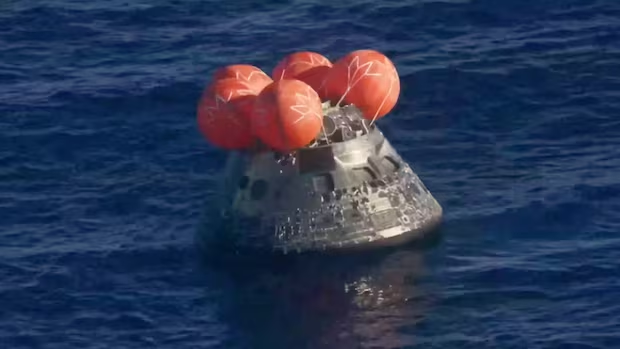
The recovery operation itself involved a massive coordination between NASA and the U.S. Navy. The USS John P. Murtha served as the primary recovery vessel, proving that the logistics of bringing humans back from deep space are as complex as the launch itself.
Ensuring Safety and Reliability
One of the most critical components of the Artemis II Moon mission was the heat shield. After minor anomalies were noted during the uncrewed Artemis I flight, engineers made several adjustments. The smooth re-entry on Friday confirms that those changes worked, providing a safe “shield” for future astronauts who will travel even further into the solar system.
The “splashdown” isn’t just an end; it’s a validation. It proves that we have the technology, the bravery, and the global will to become a multi-planetary species.
Frequently Asked Questions (FAQs):
How long did the Artemis II mission last?
The mission officially lasted 10 days, launching on April 1, 2026, and splashing down on April 10, 2026.
Who were the astronauts on Artemis II?
The crew included NASA astronauts Reid Wiseman (Commander), Victor Glover (Pilot), Christina Koch (Mission Specialist), and Jeremy Hansen (Mission Specialist) from the Canadian Space Agency.
When is the next Artemis mission?
NASA is currently targeting 2028 for Artemis III, which will be the mission that finally returns humans to the lunar surface.